|
Programming Taskbook |
|
|
||
|
Electronic problem book on programming |
||||
|
© M. E. Abramyan (Southern Federal University, Shenzhen MSU-BIT University), 1998–2026 |


|
|
Download Programming Taskbook for LINQ - Version 1.4 (English and Russian) OverviewThe software complex "Electronic Problem Book on LINQ Technologies Programming Taskbook for LINQ" (PT for LINQ) contains additional components of the electronic problem book Programming Taskbook that allow performing tasks related to the LINQ technology of the .NET platform. To use this complex, it should be installed in the system directory of the base version of the electronic problem book Programming Taskbook version 4.11 or higher (usually the system directory of the problem book is C:\Program Files\PT4). Version 1.2 of PT for LINQ is intended for use with the base version of the electronic problem book Programming Taskbook version 4.15 or higher. Version 1.3 of PT for LINQ additionally contains 64-bit versions of libraries with task groups, which allows it to be used for 64-bit programming environments (provided the base version of Programming Taskbook is version 4.21 or higher). Furthermore, it added the ability to select the interface language for the installer. Another feature of version 1.3 is that in its tasks, the initial file data contains only characters from the ASCII set, which allows performing tasks without considering the specifics of different encodings. Version 1.4 added full English interface support: when performing tasks, you can use task descriptions in either Russian or English. The PT for LINQ complex is a freely distributed software product (freeware); it can be used both with the full version PT4Complete and with the freely distributed mini-version PT4Mini. The PT for LINQ problem book includes the groups LinqBegin (60 tasks introducing LINQ queries), LinqObj (100 tasks on using the LINQ to Objects interface for processing sequences and sets of interrelated sequences) and LinqXml (90 tasks on using the LINQ to XML interface for processing XML documents). The LinqBegin group contains the following subgroups (the number of tasks in the subgroup is indicated in parentheses):
The LinqObj group contains the following subgroups:
The LinqXml group contains the following subgroups:
Tasks can be performed in C#, Visual Basic .NET, and F# in environments supported by the base version of Programming Taskbook. For version 4.26 of the base version, these are Visual Studio 2017–2026 (languages C#, Visual Basic .NET, and F#), Visual Studio Code (language C#), SharpDevelop (languages C# and F#). Furthermore, the Programming Taskbook for LINQ is integrated into the PascalABC.NET system version 3.0 and higher.
The PT for LINQ problem book provides the same capabilities when performing tasks as the base Programming Taskbook; in particular, it provides the student's program with initial data, checks the correctness of the results obtained by the program, and saves information about each test run of the program in a special file. Besides, PT for LINQ provides additional features that simplify working with sequences:
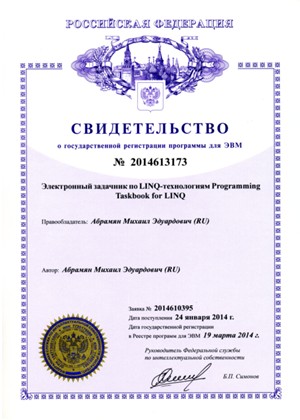
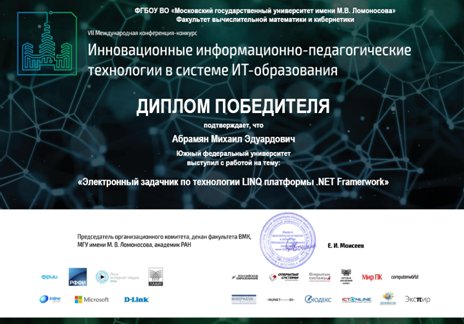
The software complex "Electronic Problem Book on LINQ Technologies Programming Taskbook for LINQ" was registered in the Register of Computer Programs on March 19, 2014 (certificate of state registration of the computer program number 2014613173). The work "Electronic Problem Book on LINQ Technology of the .NET Framework Platform" was among the winners of the VII International Conference-Competition "Innovative Information and Pedagogical Technologies in the System of IT Education" in the nomination "Information and Pedagogical Technologies in IT Education".
|

|
|
Designed by M. E. Abramyan
and V. N. Braguilevsky |
Last revised: |